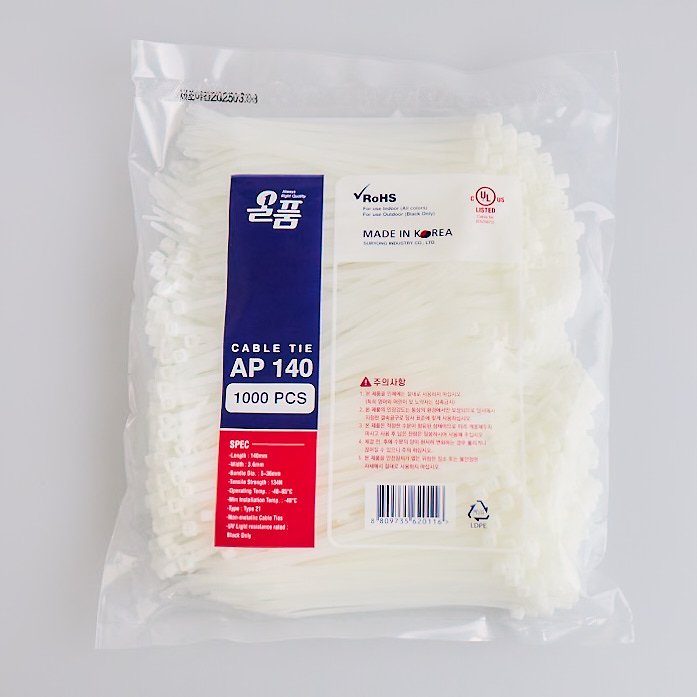
When choosing cable ties, we are often asked, "It says UL94 V-0, so it is UL certified, right?" Both carry the UL name, but one is a burning rating for the resin and the other is a certification of the finished product. Here is what V-0, V-2 and HB mean, and how the resin rating and product certification differ for each ALLPUM product.
UL94 is a burning test on resin specimens
In UL94, a flame is applied to a bar-shaped specimen made from the plastic resin and then removed. The test looks at how quickly the flame goes out and whether burning drips ignite cotton placed below. Specimens tested upright receive a V rating; specimens tested lying flat receive an HB rating. Because the same resin is rated separately at each specimen thickness, always read the thickness listed next to the rating.
| Rating | Specimen position | Criteria (summary) |
|---|---|---|
| V-0 | Vertical | Flame out within 10 seconds of removal; drips do not ignite the cotton |
| V-1 | Vertical | Flame out within 30 seconds; drips do not ignite the cotton |
| V-2 | Vertical | Flame out within 30 seconds; burning drips may ignite the cotton |
| HB | Horizontal | The flat specimen burns more slowly than a set rate, or goes out before a marked line |
From strictest down, the order is V-0, V-1, V-2, HB. The rating only describes behaviour in a flame, though. V-0 does not mean higher tensile strength or a higher service temperature.
Flame rating and service temperature are different properties
ALLPUM APF flame-retardant ties and APH heat-resistant ties show this well. APF uses UL94 V-0 resin and is rated for -40 °C to 85 °C. APH uses UL94 V-2 resin but is made for heat up to 120 °C. If the goal is to slow the spread of fire, consider APF; for places that stay hot, such as engine compartments and industrial machinery, consider APH. Tensile strength is the same for both at the same size.
Check the thickness on the resin data sheet as well. The APF resin earned its rating on specimens from 0.4 to 3.2 mm and the APH resin on specimens from 0.40 to 3.0 mm, while APF and APH ties are 1.0 to 1.4 mm thick. This compares resin specimen results; it is not a test result for the finished cable tie.

Check product certification on the certificate
UL certification of a finished cable tie is separate from the resin rating: it means the cable tie itself was evaluated to a product standard such as UL 62275. The UL certificate held by Suryong's Gwangju headquarters (File E525872) covers non-metallic cable ties to UL 62275 and CSA C22.2 No. 62275, and it lists the covered model numbers. The certificate also states that only products bearing the UL Mark should be considered UL Certified.
| Product | Resin flame rating | Product certification | Made in |
|---|---|---|---|
| ALLPUM AP (Korea) | UL94 V-2 | UL 62275 certified (File E525872) | Gwangju HQ plant |
| ALLPUM AP (Thailand) | UL94 V-2 | No UL product-certification claim | THAI SURYONG TECH |
| Flame-retardant APF | UL94 V-0 | In preparation | THAI SURYONG TECH |
| Heat-resistant APH | UL94 V-2 | In preparation | THAI SURYONG TECH |
Read the "V-0" or "UL94 V-2" on wire connector and push connector specifications the same way: they state the flame rating of the body material (PVC or PC).
What to check before buying
- Resin rating Which of V-0, V-1, V-2 or HB it is, and at what specimen thickness, from the resin data sheet.
- Product certification The certificate number, standard (such as UL 62275) and covered models, from the certificate itself.
- Place of manufacture Even for the same specification, certification scope can differ by place of manufacture.
- Service conditions Choose between APF and APH depending on whether you need flame retardancy or continuous heat.