
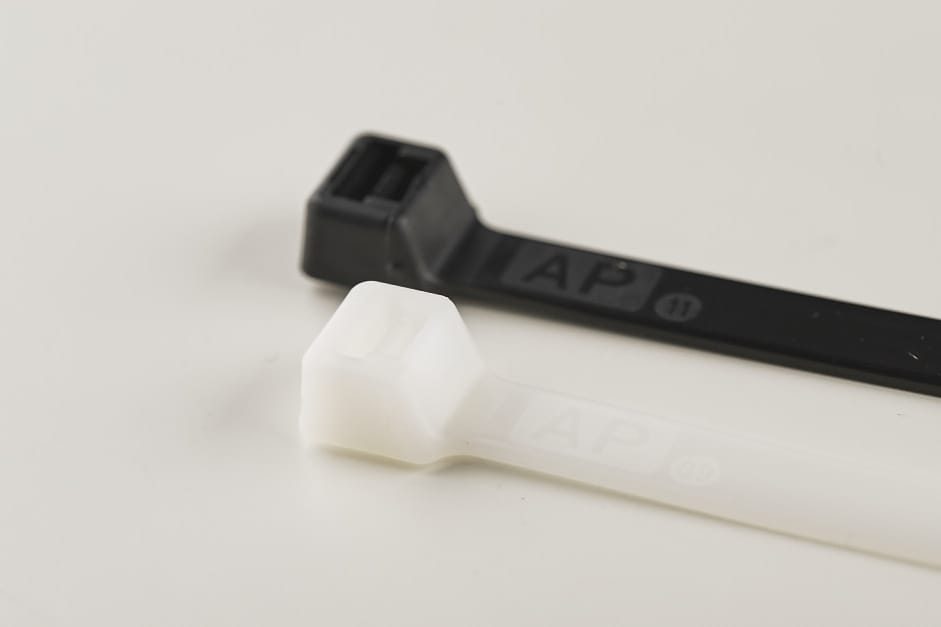
Cable tie quality inspection: why cold testing matters and how it works
Cable ties, essential in modern industry and daily life, bundle and secure wires and all kinds of items. They are used widely across industries such as electrical, telecommunications, construction and manufacturing, and must perform reliably even in extreme environments.
However, the lower the temperature, the more likely the physical properties of plastic are to change, which can reduce a product's durability. The process of preventing this problem and verifying that ties keep their best strength at low temperatures is the cold resistance test.
In this article we explain in detail why cold testing is needed, how it is carried out and what quality control processes Allpum cable ties go through.
The role of cable ties and why consistent quality matters
A cable tie is not just a fastening product — it is a key element directly linked to safety. When it secures wires or cables, a broken tie can cause electrical faults, data loss or structural problems, which could even lead to injury.
Cable ties must therefore keep performing reliably without deforming under a range of environmental factors: ▲ high temperatures ▲ low temperatures ▲ moisture ▲ UV exposure. Below freezing in particular, plastic contracts and the risk of cracking increases, so cold testing to verify this in advance is essential.
Why cold testing is needed and what it is for
The cold resistance test is a quality test that evaluates whether cable ties keep sufficient strength and flexibility at low temperatures.
Cable ties are generally made from polyamide (nylon) plastics, and the strength of these materials can change with temperature. For example, a tie that fastens flexibly at 20 ℃ becomes hard below -20 ℃, increasing the chance of cracking.
Main reasons cold testing is needed
- Verifying durability Confirms that cable ties do not break and keep sufficient tensile strength at low temperatures
- Maintaining function Evaluates whether ties still fasten smoothly at low temperatures and do not loosen in use
- Strengthening safety Checks that the product performs reliably even in extreme weather (snow, frost, cold storage, etc.)
- Improving reliability Ensures that products supplied to the market meet a set quality standard so customers can use them with confidence
Main steps of the cold test
Allpum's cold test for cable ties follows international quality control standards and is designed to ensure products work properly in a wide range of industrial environments.
The cold test is carried out in the following steps:
Creating a low-temperature environment
The cable ties are placed in a dedicated cold chamber and cooled to a set temperature. Test temperature: generally set between -20 ℃ and -40 ℃ · Test time: tested after cooling for at least 2 to 24 hours · Environmental conditions: humidity and airflow are controlled for natural cooling and a uniform low temperature
Tensile strength test
The cooled cable ties are pulled with a set force to measure tensile strength. Measuring the breaking point: checks whether the tie breaks when a given load (e.g. 22 kg, 50 kg) is reached · Comparing strength at low temperature: compares strength at room temperature with strength after cooling
Checking fastening force and breakage
After cooling, the cable ties are fastened under conditions similar to real use to check for deformation. Checks for cracking when tightened by hand · Testing with mechanical tension
Reliability analysis and quality evaluation
Based on the test results, we evaluate whether the product keeps its specified performance, and products that fall short of the standard are not shipped.
Allpum's thorough quality management system
Allpum cable ties are not just fastening tools — they are high-quality products designed with customer safety as the top priority.
To that end, in addition to cold testing, we carry out the following quality tests every day.
Main quality tests for Allpum cable ties
- Tensile strength test
- High temperature & UV resistance test
- Chemical resistance test
- Humidity resistance test
- Long-term durability test
Through these processes, Allpum cable ties guarantee the highest level of quality for reliable use even in extreme environments.
Conclusion: choose cable ties you can trust
Cable ties are not simple consumables but important industrial products directly linked to safety.
It is therefore essential to choose products that keep consistent quality whatever the climate, temperature or environmental conditions.
The strengths of Allpum cable ties
- Strong durability that won't crack even at -40 ℃
- Thorough quality control and compliance with international standards
- Product reliability you can count on, even on industrial sites
If you're looking for cable ties whose performance doesn't change in the cold, Allpum cable ties will be your best choice.
Try Allpum cable ties today!