
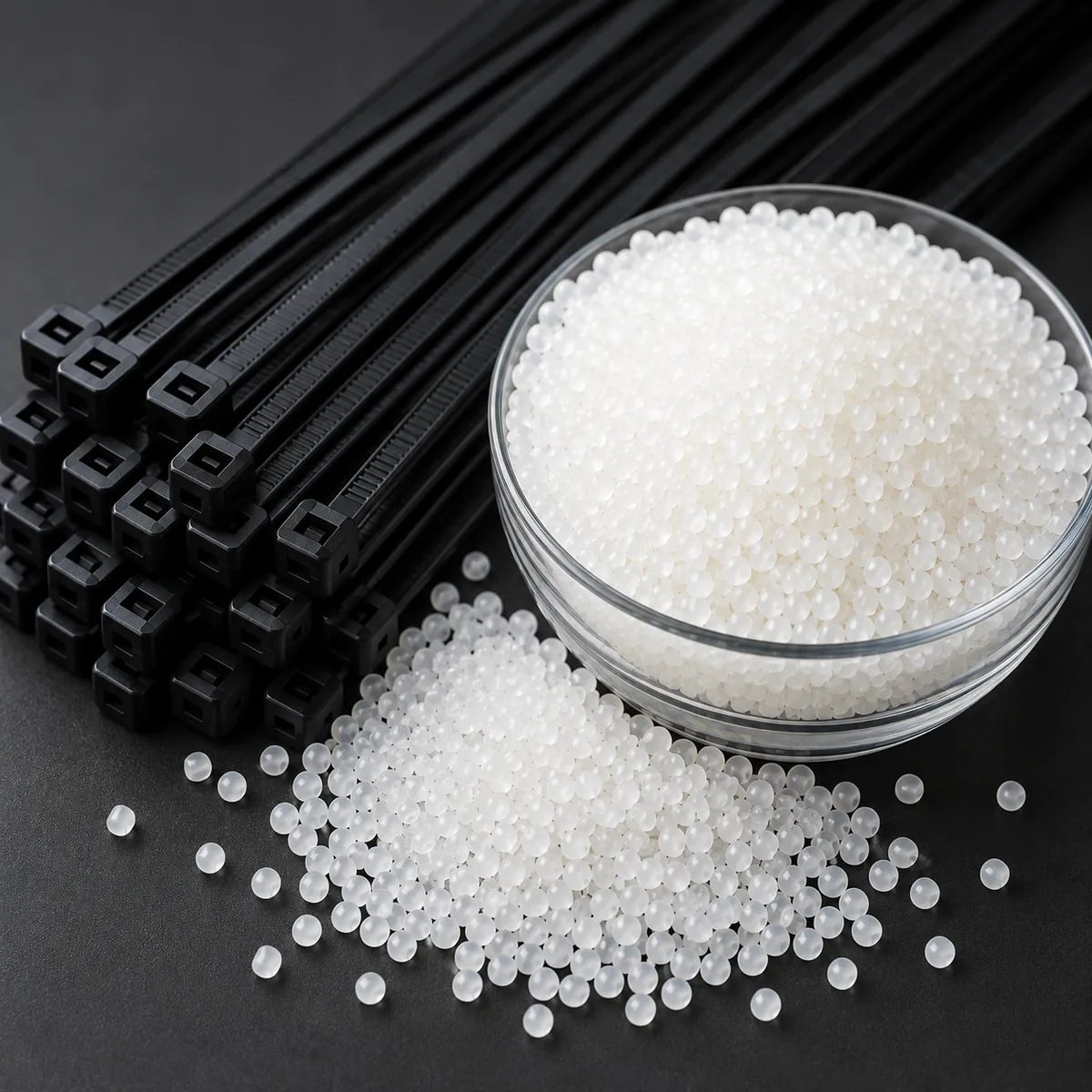
On industrial sites, the cable tie is a quiet helper that is always close at hand. It is used in almost every field, from bundling wires and fixing pipes to packaging goods for logistics, yet few people stop to ask why this small part is made from a particular material. The raw material that most readily comes to mind is PP, or polypropylene — cheap, light and widely used. So why do cable tie manufacturers around the world insist on nylon 66?
Material is not just a matter of cost
A cable tie is not simply a piece of moulded plastic. If this small strap comes loose or breaks, wiring falls apart, machines stop and the whole site can be put at risk. In the end, choosing a material is not about cutting costs — it is a question of safety and trust. That is why the industry has long used proven nylon 66 as the standard material for cable ties.
The strength of nylon 66
Nylon 66 is tough yet flexible. Once fastened, it is strong enough not to break easily, while also having the elasticity to absorb external impact. Above all, it can be used reliably in a wide range of environments, which suits cable ties well — because it is important to maintain basic fastening performance both in cold winter conditions and on hot industrial sites.
PP, on the other hand, is cheaper but has relatively low mechanical strength, so it is more likely to break where it is under tension. It also deforms easily at high temperatures and can become brittle at low temperatures, making long-term reliability on industrial sites hard to achieve.
Why nylon 66 cable ties are chosen
- Stable tensile strength that doesn't loosen easily once fastened
- Durability suited to electrical, telecom and plant sites
- Relatively stable properties at low and high temperatures
- Material properties that make it easier to meet global certifications such as UL, RoHS and REACH
How it became the global standard
Meeting international standards matters too. Global certifications such as UL, RoHS and REACH are not just marketing labels — they give confidence that a product meets specific safety and environmental standards. Nylon 66 is well suited to obtaining these certifications, and as a result it has become the standard raw material for cable ties on the global market.
The difference you feel on site
When we talk with industrial customers, we sometimes hear that cheap cable ties snapped easily in winter or loosened some time after fastening. Problems like these are closely linked not only to product design but also to the quality of the raw material. Cheaper products may seem to cut costs in the short term, but over the long term they can lead to rework and losses on site.
Genuine nylon 66 cable ties deliver stable performance in fastening force, durability and resistance to environmental conditions. In the end, these differences decide what is chosen on industrial sites.
Where things are heading
Recently there has been a rise in improved products that add UV stabilisers, flame retardants and chemical-resistance additives to basic nylon 66. This reflects a move beyond a simple fastening tool towards meeting the special conditions of specific industries. Yet the starting point is still nylon 66 — a sign of how solid the material's basic performance is.
Conclusion
Cable ties may look trivial, but they are parts where a small failure can lead to a big problem. That is why the industry chooses nylon 66, not PP. Taking into account strength, heat resistance, cold resistance and flame retardancy, nylon 66 is a cable tie material that can be trusted for the long term. In the end, nylon 66 cable ties are close to the standard choice on industrial sites.
Backed by its Korean manufacturing base and quality management system, Allpum reliably supplies nylon 66 cable ties in every size for repeat purchase by electrical, telecom and industrial sites. For product specifications, wholesale supply or export enquiries, please contact Suryong Industrial.